Tuesday, November 6, 2007

The Children's Space at St. John's


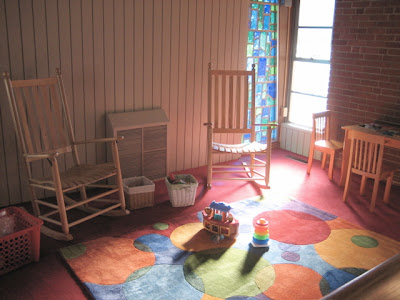
We just added a Children's Space at the back of the church. I had seen this done in a number of parishes in Wales, Scotland and England and since we had this lovely wide space at the back, and no nursery at this point, it seemed like an easy way to help families with young children feel welcome.

There are two rocking chairs and some baskets of books (some for very young children and some for the older chidlren in the congregation). Each week there are coloring pages and puzzles that relate to the gospel or something about our Episcopal worship in ziplock bags with colored pencils and crayons. Children can do these in the Children's Space or take them to their pews.

We added a colorful rug and a small table with puzzles (Melissa and Doug are now doing a whole series of puzzles based on Bible stories--I especially like the one of Jonah). There are some simple toys--the criteria was that everything in the area has to be able to be easily cleaned with a clorox wipe or thrown in the dishwasher for sterilizing (I learned this working in children's museums for 15 years).

The Children's Space has been well received its first two weeks. A parishioner was here on Sunday with his very active three year old grandson and he seemed very happy throughout the service. Isn't this what we want? For children to feel comfortable and welcome and happy coming to church. We want it to feel like the home we hope it is for them.

Monday, November 5, 2007

Sermon for All Saints Sunday 2007

AND I MEAN TO BE ONE, TOO

Today we celebrate All Saints Day .
All Saints Day is one of the principal feasts of our church.
In other words, it is a big deal.
It is such a big deal that when the official date of November 1st
doesn’t fall on a Sunday
we transfer the celebration of All Saints Day
to the Sunday that follows.

The reason for this is simple—
we don’t want to miss this celebration--
this celebration which reminds us
how connected we are to one another
and how connected we are to God.

As early as the third century,
the Church has designated a single day to commemorate
the martyrs of the church,
those who were willing to die for Christ—and did.

In our modern church,
All Saints Day commemorates not only the martyrs,
but all God’s children, both living and dead,
who have led and strive to lead
good and faithful lives.

We all form “the mystical body of Christ”,
as we heard in today’s collect.
That means that you and I, as people of God,
are connected to one another,
and we are connected to all God’s people who have gone before us
and all God’s people who will come after us.
That makes us one BIG (!!!) family. All saints.
I sing a song of the saints of God…
We sang that song as our sequence hymn last week
And we sang it again today.
We sang it last week because we were dedicating our new children’s space—
a special area for our littlest saints.

We sing it this day
because we celebrate All Saints Day—
and we celebrate Justin’s baptism--
plus it is just worth singing again.

Listen to these words—
They lived not only in ages past
There are hundreds of thousands still…

The hymn continues…
You can meet them in school or in lanes or at sea
In church or in trains
Or in shops or at tea…

The first time I ever heard this hymn I laughed.

I laughed out loud.
The words just struck me as funny=--in a delightful way—
It sounded more like a Dr. Seuss book than an Episcopal hymn!

But don’t you just love it that we can walk out of our house on any given day
and bump right into a saint—
At school or in the grocery store or
or having a cherry limeade at Sonic.

And the wonderful closing line of that hymn…
…and I mean to be one, too.

I mean to be a saint, too.
God wants us to dream that.

It is why we renew our baptismal covenant on All Saints Sunday.
It is why this Sunday is set aside
as one of the Sundays when baptisms are encouraged.
When I spoke with Justin about his baptism
I told him that I believed in God’s eyes
he had been a saint from the moment of his birth
But today, with his baptism here at St. John’s,
we are going to make it official!

The promises we make in our baptismal covenant
are our guide to becoming true saints of God.

We renounce evil.
We renounce everything that draws us away from the love of God.
We put all our trust in God’s grace and love.
We promise to look for the face of Jesus in every one we meet.
We promise to strive for justice and peace.
We promise to respect the dignity of every human being.

These are BIG promises.
We need a BIG day like All Saints to hold the enormity
of our baptismal covenant.
When we say those words
I can just imagine Jesus flying a plane across the skies over St. John’s
And skywriting the words,
WOW! Did you hear what you just said!!??? WOW!!

Our gospel reading today is from Luke’s gospel.
This scripture text, as well as a similar text in Matthew’s gospel,
Is known as the beatitudes, the blessings.

Luke has 4 blessings and 4 woes.
We all know what a blessing is but maybe you are wondering,
Just what is WOE?
Woe is like saying “You are so out of luck.”
The woes are the dark side or the reversal of the blessings in Luke’s gospel.

The blessings Jesus gives in Luke’s gospel are all for those who live difficult lives:
The poor
The hungry
Those who weep
Those who are rejected, hated, excluded.

Then Jesus places woes on those with lives we would see as easy (and desirable):
The rich
The full
The laughing
The accepted, those people speak well of.

When we first read or hear Luke’s four blessings
We are likely to say, Good!
I’m glad that God loves the poor, the hungry, the weeping, the rejected.
They need God’s love.

But then come those woes.
And we are likely to say UH-OH!
Because the truth is, for most of us,
we sound a lot more like the people of the “Woe to you”
than the “Blessed are you” people.

These blessings are not meant to exalt poverty or hunger or grief or victimization.
They are not virtues we are to seek.
This is Jesus saying, bad stuff happens in this world.
Bad stuff happens to good people.
Life is terribly hard for some of God’s children.

And neither are these woes meant as retaliation by God.
These woes are not revenge against the rich or those with enough to eat
or those who are happy
or those who are respected.

Jesus is telling us is two things:
One: our position in life, our position in the world,
can change in a heartbeat.
Two: we are all connected, one to another, as children of God,
And if some are hungry and heartbroken and hurt
then we need to understand that part of our work in God’s world
is to reach out to those who are suffering.

In Jesus’ time most folks thought if things were going good for you,
it was because God was pleased with you.
And if things were going badly—if you were sick or poor—
then God was angry with you.

But Jesus says over and over to us,
that is SO not true.

God’s ways are love and forgiveness, and grace.
The saints of God are the tangible presence of love and forgiveness and grace
being lived out in this world.

All Saints Day is a wonderful time to reflect on our blessings,
to think about the saints in our lives
those who have rescued us from woe, from sorrow, from disaster.
Those who have been the face of Jesus for us.

I want to share with you three of my saints.

My mother is one of my saints.
As a teenager, I used to roll my eyes at the way she waited on my father.
I wanted her to be liberated!
Then I grew up and began to see that what my mother did for my father
was done out of pure love.

My mother was a very strong woman
but when my father died,
when you lose the person who has been the love of your life
for over 50 years,
your heart aches.
In my mother’s weakness, I saw her deepest strength—
her immense capacity to love.
Blessed are you who weep now.

I met another saint on my first mission trip to Panama.
His name is Daniel.
He was a teenager at the time.
I was part of a group of seminarians
who worked with a group of Panamanian Episcopalians
to help renovate the chapel
at their youth camp.
On our last day there,
we were getting ready to leave,
and those of us heading back to the States,
decided we were going to throw away
our old tennis shoes we had worn all week.
We had purposefully brought our oldest, rattiest shoes for that week of work.
Our shoes at week’s end had paint, cement and a lot of dirt covering them.
Not something we wanted to pack and bring back home with us.

As we were changing shoes, getting ready to toss our old ones in the garbage,
the man from one of the Panamanian Episcopal churches
who had coordinated the work week came up to us
and asked us if we would be offended
if he gave our shoes to some of the workers there.
We were a little embarrassed,
but said, no, that was fine.
Daniel was one of the workers who had been selected to
receive a pair of our shoes.
When he came over he was so excited.
When I looked down,
I saw that his own tennis shoes were tied onto his feet
with a pair of shoe laces.
The bottom had long ago come apart from the top of the shoe.
He had worked all week in those shoes
And I had worked right beside him --
and I had never even noticed.
Blessed are you who are poor
for yours is the kingdom of God.

Remember that hymn I sing a song of the saints of God?
I told you it made me laugh when I first heard it.
That hymn also made me cry once.
It was one of the hymns sung at a burial service for my friend Tori
who died of cancer when she was 34 years old.

Tori did not pick that hymn for her burial service
because she felt SHE was a saint--
She picked that hymn
because she felt one of the gifts she received from her illness
was having her eyes opened to all the saints who surrounded her.
Her husband, her friends, her sister, her neighbors, the doctors and nurses.
Tori even included their dog Daisy among her saints.
Daisy would come up and lick Tori’s face
just like Tori was a puppy who needed special care.

Why do we celebrate All Saints Day?
As a reminder:
To remember those we love but see no longer.
To remember the saints that are still with us every day.
To inspire us to be one, too.

There are a myriad of wonderful saints throughout the history of the church.
They all belong to us.
But there are a myriad of saints right here, too.

I look out on this congregation of St. John’s
and it is not just John who is our saint---
there is Saint Sheila and St. Roberta and St. Anne and St. Stacy and
St. Susan and St. Chris and St. Eddie and St. Sandra and St. Joe…
…and on and on and on.

The saints of God—right here in front of us,
right here beside us, right here behind us,
right here all around us.

As my grandmother would say,
If you threw a stick, you’re bound to hit one.

I am NOT advocating throwing sticks—certainly not in church!!!
I AM advocating that we open our eyes
and see the saints that bless our lives everyday.
I AM advocating that we strive to live into our baptismal promises:

For the saints of God are just folk like me—and YOU--
And we mean to be ones, too.

And there is one among us today,
who really means to be one, too.

So let us gather at the font now and baptize Justin…

.

Wednesday, October 31, 2007

Sermon for Year C Pentecost 21 Proper 25

SEVEN WORDS. TWO STATEMENTS. ONE QUESTION.

Because we get to the read the Bible from the 21st century,
we have come to think of the Pharisee as the “bad guy,”
the hypocrite,
the arrogant “I am so much better than you” sort of person.

And certainly in this parable Jesus gives us some reasons to believe just that.

But in truth, in Jesus’ time, the Pharisees were generally the model
for religious good works.
The Pharisee is a faithful man.
He follows the religious codes of the day.
He tithes.
He always shows up for worship,
He comes to the temple and prays.

Yes, in this parable we hear that edge of pride and self-righteousness-
because the Pharisee does thank God
that he is not like thieves, rogues, adulterers or tax collectors.
But haven’t we all looked at some other people
And at least thought, Whew! I am glad I have my life and not theirs.

This parable is not about how the Pharisees are bad.

This parable is about seven important words, two confessional statements,
and one hard to ask question.

The seven words are the words of the tax collector:
God, be merciful to me, a sinner.

The tax collector is a sinner indeed.
We can’t put our modern cast on this man.
Being a tax collector in the first century
is not comparable to working for the IRS today.

Tax collectors were despised.
Being a tax collector meant you preyed on your own people
for your own personal gain,
You collaborated with the Romans.

The Romans were the oppressors.
They had deprived people of their freedom and their dignity
and a good share of their money.

The Romans had little respect for the one God of the Israelites,
Their focus was on protecting their own government
and raising the funds they needed to do just that.
Who needs God when you have the government?

The tax collectors took more than their fair share—
First they took what the Romans wanted
And then they took whatever else they wanted.
It’s why you became a tax collector—
the Romans let you collect whatever amount you chose to collect.
Being a tax collector was the “get rich quick” scheme of the first century.
It was also a definitive way to “get hated quickly”.

So yes, no one hearing Jesus’ parable about the tax collector and the Pharisee
would argue with the tax collector’s assessment of himself as a sinner.
But they would have been shocked
to hear Jesus say that God will exalt,
that God loves, this tax collector.

To be honest, if we are truthful
about who we would like to add to our church membership,
it would likely be the Pharisee—
he faithfully shows up at for worship and prayer.
You don’t have to remind him to make a pledge—
he tithes (that’s 10 percent of his income, folks!)
He follows the ten commandments.
Sounds like a potential star vestry member to me!

Who wants a greedy tax collector next to them in their pew?

Jesus says, God does.
Jesus says, God loves us all.
God loves even those we cannot find in our heart a way to love.

Jesus is not giving out a message that says,
Oh, don’t bother to pray,
Just show up at church whenever you’re not too busy,
and forget about making a pledge
or living a moral life.
Jesus is not saying,
Go out and sin! It doesn’t matter to God one iota.
He loves you any way.
That is not the message here.

Jesus is saying,
If you get off track, if you make mistakes,
if you find yourselves lost in a maze of what feels like unforgiveable sins,
God is still here.
Ever-present, ever waiting for you—or me—to show up.
To come home.

But we need to show up with those seven words:
God be merciful to me a sinner.

It’s not a magic prayer.
You can’t just say the words
And poof! Everything is just hunky dory.

These seven words are not just a pre-emptive apology.
These seven words are sometimes all we have left if we have hit bottom:

God, be merciful to me, a sinner.

So those are the seven important words.
What are the two confessional statements and the one difficult question?

You are not going to find those word for word in this gospel reading.
Those I found on the Oprah show.
True.

A friend sent me an email and said you gave to go on line to oprah.com
and listen to a lecture by this college professor named Randy Pausch.

Randy Pausch is a computer science professor at Carnegie Mellon University.
Carnegie Mellon has a lecture series titled “Journeys”—
only originally it was “The Last Lecture.”
Essentially a professor is invited to give a lecture
of what they would say to their students,
if it was the last lecture they would ever give,
the last words of wisdom they could ever offer.

The ironic thing about Randy Pausch delivering this lecture
is that it may really be his last lecture.

Randy has pancreatic cancer.
He has battled it in every medical way possible-
but for this brilliant young professor, the strife is almost over.
He is, most likely, in the last months of his life.

Randy says many things in this lecture
but the one thing that really struck me,
especially in light of today’s gospel,
were two statements and one question.

Randy is giving advice on how to live a fulfilling life,
a happy, and we might add, a holy, life.

He tells his students—over 400 people showed up that day
to listen to his lecture—
you have to learn to say.
“I’m sorry.”
That is statement number one.

But you cannot stop there.
Next you have to be able to say words that are very, very difficult
for many of us to say:
“I was wrong.”

We all know we live in a culture of blame.
It is never our fault. It is always someone else’s fault.

We blame everyone around us rather than taking responsibility,
rather than holding ourselves accountable.
It’s a mean ol’ cruel world and everybody is always after me.
For most of us, that is just not true.
We make mistakes. We mess up.

This is the heart of today’s parable.
The tax collector IS holding himself accountable.
The tax collector is there before God and saying,
I messed up big time.
It is my fault.
I was wrong.
I am sorry.
Please forgive me.
Have mercy.

But Randy Pausch doesn’t leave it there.
He says there is still a question that has to be asked:
How do I make it right?

Often our apologies are just a way to slip out of sticky situation.
Sorry.
And off we go.

That is different than:

I’m sorry.
I was wrong. It was my fault.
How do I make it right?

I am not here today to preach the gospel of Randy Pausch.
But his story, his clear words offer us a window into the gospel,
a window into our own lives.
a window into our worship

In our worship we have a part of the service called the Confession.
This is not just a perfunctory part of the liturgy.
It is very purposefully there.
For you and for me
to say,
to admit, to confess, week after week,

I’m sorry.
I was wrong.
How do I make it right?

It is why we begin the confession with silence.
That little quiet space
before we begin to say the words of the confession aloud and together.—
that little silence has a “RESERVED” sign placed on it
just for you and for me individually.
What do you need to confess?
What do I?
Where have we gone wrong this week?
Where have we blamed someone else for something we have done?
Where have we been cruel or thoughtless or ignored someone?
That little bit of silence is to give us time to fill the blanks for our own sins.

Sin is anything that separates us from God or from our neighbor.

We confess our sins and we are asked to mean it.
We are asked to understand that we are on our knees or standing before God
and God is taking a close look into our heart.
We might be able to fool everybody else
but we cannot fool God.
God knows the truth.
God knows everything about us and everything about our lives.

God is present. There for us.
But if we cannot tell the truth,
if we cannot say,
I’m sorry.
It was wrong.
How do I make this right?--
Then it will be very, very hard for God to come in the door of our lives.

Blaming others is a padlock—on our lives, on our hearts,
on our relationship with God
and certainly on our relationship with other people.

If we cannot say those seven words—
God have mercy on me a sinner—
Perhaps it is because we believe that God doesn’t really love us,
can’t possibly love US, love ME!
But that is so not true.

God’s love is not what is in doubt.
God’s presence is not what is in jeopardy.

There is a wonderful scene in the old film CITY SLICKERS
when one of the characters has messed up and in despair he says,
I’m 40 years old and my whole life has been a mess, a total waste.

The Billy Crystal character assures him, it’s really okay.
He tells his friend he can have a “do-over.”
You get a chance to try again, you get a chance to make it right.

God is the do-over champion.
God gives us another chance.
God gives us mercy.
God loves us.

In our service of Holy Eucharist,
after confession comes absolution.
I as the priest stand here and hold up my hand to forgive you.
I don’t forgive you as your rector.
I forgive you in the name of God.
I forgive you—
but it is between you and God
as to how you will make it right—
to the person you have hurt, to the people you have blamed,
to your self whom you have disappointed.

After confession and absolution
We celebrate.
We offer God’s peace to one another
And then the bread and wine is offered to us.

God gives us everything.
God gives us more than we can ask or imagine.
We come forward and God blesses us with a do-over.
Start again. Try again.
We are called over and over
to open our hearts to the love and abundant grace of God.

Do not for a minute believe we have earned it.
It is pure gift.

Randy Pausch said he wrote his lecture not for his students--
and he loves being a teacher--
but he wrote his “last lecture” for three reasons—
Chloe, Logan and Dylan —his three young children.
This is the legacy he wants to leave his children.

This would be an amazing legacy for all children.
Know that God loves you.
Know that God forgives you
Know that God expects you to be responsible for your actions in life.
Know that God wants you to be aware of when you hurt others,
when you hurt yourself.
Know that God weeps
when you are hurting.

Learn how to say
I’m sorry.
I was wrong
How do I make it right?

God gives us a do-over.
We just need to be wise enough to take it.

God, have mercy on me a sinner.
Tuesday, October 23, 2007

Who is that masked girl?


Everyone had fun when Jo Ellen came and brought many beautiful and colorful handmade items from Panama.

Monday, October 22, 2007

Panama comes to St. John's


Jo Ellen Nutter, a missioner with the national Episcopal church who coordinates medical mission in Panama, was in Asheville and joined us at St. John's for Saturday evening and Sunday morning services and adult forum. It was inspirng to hear about the work that she does in Panama and to learn more about mission. Our congregation is discerning what mission will look like for St. John's. I won't be posting a sermon this week as Jo Ellen and I did a "duet" sermon--with me reflecting on the biblical context of the texts and Jo Ellen reflecting on how these texts are lived out in the mission work in Panama.

There are 75 missioners from the national Episcopal church who are committed to long term mission work. Regardless of our involvement in short term mission work, these long term missioners need the support of both individuals (that's us) and our parishes. You can check out Jo Ellen's blog (Hasta, Inc) on the link on this blog. What a joy it was to be with her.

Thursday, October 18, 2007

Two sermons for Pentecost 20

We have two services at St. John's--a 5 p.m. service on Saturday evening and an 11 am service on Sunday morning. I usually preach basically the same sermon at each. This past weekend was different as we had a baptism on Sunday morning and it just didn't seem to work to preach the baptism sermon on Saturday since there was no baptism. So I preached on the gospel on Saturday evening and the Old Testament reading on Sunday morning. Both are posted here. Blessings.

Sermon Year C Pentecost 20 Proper 23
Luke 17: 11-19
St. John’s Episcopal Church, Asheville, NC
Saturday, October 13, 2007

GIVING THANKS

Writer Anne Lamott says there are basically two prayers:

The first prayer is HELP ME! HELP ME! HELP ME!

The second prayer is THANK YOU! THANK YOU! THANK YOU!

We are probably a bit more experienced with that first prayer—
As we become painfully aware of our need for God’s help
during times we are in trouble or despair.

Help me find a job…
Help me sell my house…
Help me pass this test…
Help me heal from this illness, this injury, this heartbreak…
Help my children…
Help my parents…
Help the one I love…
Help me.

Our gospel reading in Luke today is about ten people who need help.
And about one person, upon receiving that help, who stops to say thank you.

These people needing help are lepers.
Lepers are not just biblical characters.
Lepers still exist today.
And leprosy is still a horrific disease,
Though, granted, there is certainly much more hope
and much better medical care today
than there was in the Middle East in the first century.

These lepers in Luke’s gospel are desperate.
They see Jesus and they cry out
“Have mercy on us!”

They cry out from a distance because leprosy is contagious
and those with this disease were ordered by law to keep a certain distance
from anyone who did not have leprosy.
It was a disease no one wanted.


Because of the contagious effects of the disease,
because of having to keep your distance from everyone—
Lepers live very isolated lives.
They lose contact with their families and their friends
and living with leprosy equals a lonely life--—
physically, mentally and emotionally—
a very lonely life.

These ten lepers in Luke’s gospel are in despair.
There seems to be no help, no cure, no way out.
They cry for mercy.

And Jesus answers their cry.
“Go and show yourself to the priests.”
He sends them to the priests because that was how one was certified
as being clean, free of disease, contamination.
And they do what Jesus says—
and immediately as they turn to go,
they are healed, made clean, made whole once more.
They do what Jesus says.
They obediently go.

Except for one.
He ,too, turns to go and is healed
but he comes back.
He stops to say thank you.
Thank you! Thank you! Thank you!
And he is made truly well.

Now we mustn’t be too harsh on the 9 that did not remember to say thank you.
Imagine what it would be like
to find yourself healed of a disease that you thought was a death sentence.
A disease which had isolated you from everyone you loved.
.
Imagine the overwhelming joy when you find yourself healed.
You rush off immediately to find your wife, your husband,
your parents, your children, your dog, your cat….!!—
To share the good news,
to hug and kiss and be hugged and kissed.
Because it has been a long and lonely time.

So I don’t want to be too harsh on those nine
that did not turn back
who did not remember to say thank you.
Perhaps I don’t want us to be too harsh
Because I know that I, too, am among those who
sometimes forget to say thank you to God for my many blessings.

This gospel reading has two parts.
The first is a story about healing.
The second part of the reading is about thanksgiving
And understanding who deserves the credit for all we have,
for all we are.

One out of nine understood that.
The one who realized that his healing was a gift from God,
was a Samaritan.

The reason the person is identified as a Samaritan is not just to tell us
where this man made his home
or to identify his ethnic group.
The man is identified as a Samaritan
because Samaritans were religious outcasts.

They were considered by the faithful people of that day
as “those people,”
“those heathens,” “those pagans,”
those people who do not know God
and who are not known by God.
Jesus tells this story
God loves and includes us all in that love.
God cares for each one of us.
God does not label any of us as “those people.”

Perhaps Jesus tells this story to help us open our eyes
to “those people” we tend to disregard or disrespect
to see that “those people” may be living lives
more faithful to the gospel than we are at times.

Perhaps Jesus also tells us this story to remind us
how easy it is to take our many blessings for granted.

Perhaps Jesus tells us this story to assure us
that when we cry out,
HELP ME! HELP ME! HELP ME!
God is listening.
God will heal us
in ways that only God can heal.

Perhaps Jesus tells us this story to encourage us
to take time
to praise God
to worship God
to give thanks to God….
Not only with our words
but with how we live our lives.


HELP ME! HELP ME! HELP ME!
THANK YOU! THANK YOU! THANK YOU!

+ + +

Sermon for Year C Pentecost 20 Proper 23
The Baptism of Jared William Ray
Sunday, October 14, 2007
St. John’s Episcopal Church, Asheville, NC
The Rev. Jeanne Finan


YOUR PEOPLE WILL BE MY PEOPLE

One of my favorite movie scenes
is the opening of the film The Lion King.
It is dark, very early morning.
You hear this wonderful music
and then you see animals running across the plains of the Serengeti--
zebras and gazelles, elephants and giraffes, monkeys and leopards—
all creatures great and small--
are running and leaping and hurrying
to gather.
Something exciting, something wonderful is about to happen.

And when they arrive, as the sun rises in the sky,
up on a cliff there is a baby lion cub named Simba
and he is being nuzzled by his adoring smiling parents
(lions smile, too—at least they do in cartoon features!).
And there is the wise baboon
who anoints Simba on his forehead
and lifts the little lion cub up
and the crowd of animals goes wild with joy—
roaring and trumpeting and stomping their hooves.

And to me, that scene is what baptism is all about.
We come together.
We share the joy of a child being claimed as Christ’s own forever.
We remember the purpose and promises of our own lives.
We celebrate.
We give thanks.

Knowing we are going to baptize Wiley Ray this morning—
I cannot help but think of that scene—
This is not to say Wiley is a lion cub
and I hope you don’t think I am a baboon!

But what I do think is this:
what a joyful morning!
If we had hooves,
we would stomp.
And if we had elephant trunks
we would trumpet!

What a gift it is to gather with you,
the congregation of St. John’s
and with all our guests and visitors
and to be here this morning with Jared William Ray
on the day of his baptism.

I also thought about Wiley’s baptism
as I read the scripture passage from Ruth this week.

It is one of the most tender, heartfelt passages in all scripture.

Naomi tells her two daughters-in-law,
Orpah and Ruth,
that they do not have to go with her
as she returns to the land of Judah.
And Orpah weeps and kisses Naomi good bye and leaves.
But Ruth refuses to let Naomi go by herself, to go alone.
Ruth says,
Where you go, I will go.
Where you lodge, I will lodge;
Your people shall be my people
And your God my God.

That is love.

Wiley is here this morning to be baptized because his parents love him.
And because they love each other.
And because God loves all of them! All of us, too!

Emily and Jared want all that is good and beautiful and holy for their son.
They bring Wiley to the baptismal font this morning
so that he will never be alone.
They are willing to acknowledge that, yes,
Wiley is their beloved child,
but Wiley is also God’s beloved child.

And Wiley today becomes part of St. John’s
because we are witnesses to his baptism.
Part of our work as a congregation
is to offer our love and support to Wiley
and to Emily and Jared
wherever their spiritual journey leads them.
Our work—and our joy--is to be here for them.
Your people shall be my people
And your God my God.
Holy Baptism is full initiation
by water and the Holy Spirit
into Christ’s Body the Church.

In case you haven’t noticed,
the Church is not perfect.
Far from it.
We as human beings, as Christians, are not perfect either.
Far from it.
We have a long tradition of imperfection.
Fortunately, God seems quite understanding about that.

In our gospel reading this morning
Jesus heals 10 lepers and only 1 says thank you.
1 out of 10.
Not really even a decent batting average.
Yet, one did stop.
One person did realize what a blessing he had received.
Becoming like that one who remembered to stop,
to pay attention, to be grateful,
is our hope and our prayer.

We are not perfect.
But we are trying.

We are trying to love God and to love one another.
We are the Church.
The Church is not some abstract, theological doctrine-burdened beast.
Church is us. The people of God.
It’s real and it’s messy and it’s beautiful.

And we are yours, Wiley.
Ready or not—here we are!
Forgive us when we mess up.
I hope you will find it in your heart to love us anyway.
We, as the Church of God, are here to love you—always.

We live in a world where many things, many commitments, many promises,
can be broken, can be dissolved,
can legally be made null and void.

That is not true with baptism.
The bond which God establishes in Baptism
is indissoluble.
Baptism is once and forever.
Baptism is the promise that is never broken.

And now, let us stomp our hooves
and trumpet with joy
as we gather at the font to baptize Jared William Ray.

Wednesday, October 10, 2007

blue birthday socks


My friend Danby sent me this cool amazing pair of socks for my birthday. The amazing thing is that she knitted the socks. how can anyone knit socks? Oh I know knitters do it all the time. I have a long history of knitting...or should that be a long history of not-knitting? I taught myself to knit from the World Book Encyclopedia. I knitted a long blue scarf. Never purled just knitted. That was in high school. Then after college I knitted another scarf--stripes of many colors--and sent it to now-husband Tom who was living in Amsterdam at the time. Then right after college I went with my mother to a knitting class when i was home visiting because she wanted to learn to knit. I enrolled with her but never knitted anything but my mother knit these little sock slippers. I think she knitted about two million pairs. We all got them every Christmas. They were great for putting on and slip sliding down a hardwood floor hallway. sweet Granny's slipper socks. Then in seminary a knitting group was formed. I think I spent all semester trying to cast on. I did finally manage to knit my daughter-in-law Natalie a scarf but it was a challenge--to me and to everyone in the group who had to help me continuously. I am sure the group finally asked my friend Vickie to remind me of the passage from Corinthians about all of us having different gifts and maybe knitting didn't fall in my gift category. So i was a seminary knitting group drop out. Then it became a ministry to knit prayer shawls. I thought, I can do this. It's just an oversized scarf. Dear Jane in my parish did the casting on for me. All I had to do was follow the very very simple pattern and knit. The stitches didn't seem to stay the same count on any row...the unfinished shawl sits in a canvas bag somewhere in this house. The good thing about being a failed knitter is that you are absolutely awed when you see what others have knitted. And when you get a pair of turquoise blue (the color of the sea around Iona on some days) socks (with a cable stitch design!!!!!!!) you are absolutely awed and thrilled and sure you have the most brilliant talented friends in the whole wide world (of that I am sure).So now I have this wonderful pair of handknitted socks. What a great gift! How wonderful it is to have dear friends!